

Introduction: When Every Text Message Feels Like a Battle
It’s 3 PM on a Tuesday. Your phone buzzes. It’s your ex—again—turning a simple question about pickup time into an accusation about your parenting. Your chest tightens. Your hands shake. Welcome to high-conflict co-parenting, where even the smallest interaction can explode into warfare.
If you’re reading this, you already know: co-parenting isn’t always about friendly collaboration and shared birthday parties. Sometimes it’s about survival. About protecting your children from constant tension while maintaining your own sanity. And here’s what most people don’t tell you—traditional co-parenting advice fails spectacularly when dealing with a truly difficult ex.
But there’s hope. In 2025, we have better strategies, backed by psychology research and real-world success stories from parents who’ve found peace in impossible situations.

Why Co-Parenting Got Harder in 2024–2025 (And Why Old Advice Doesn’t Work)
Here’s the uncomfortable truth: co-parenting has become exponentially more challenging in recent years. A 2024 study from the National Institutes of Health revealed that children in high-conflict divorces now face a 46% increased risk of developing PTSD-like symptoms—up from 38% just five years ago.
Why the spike? Technology has weaponized conflict. Endless text threads. Screenshot evidence wars. Social media stalking. The 24/7 access your ex now has to trigger you didn’t exist a generation ago.
Most co-parenting articles still recommend “open communication” and “working together as a team.” That’s excellent advice—for amicable divorces. But what about when your ex uses every conversation as an opportunity to manipulate, blame, or control? What about narcissistic personalities, high-conflict individuals, or simply people who can’t let go of the marriage ending?
The biggest misconception: You need two cooperative people to co-parent successfully.
The reality: You can create peace unilaterally.

The 7 Fatal Mistakes Parents Make (And What Actually Works)
Before we dive into solutions, let’s identify what’s sabotaging your peace:
| Common Mistake | Why It Fails | Better Approach |
|---|---|---|
| Trying to change your ex | You can’t control another person | Focus on your responses only |
| Over-communicating | Creates more conflict opportunities | Minimize to essential info only |
| Defending yourself | Feeds the drama cycle | Grey rock method (emotionless responses) |
| Using kids as messengers | Damages children emotionally | Adult communication through apps only |
| Flexible boundaries | Teaches ex that limits are negotiable | Iron-clad consistency |
| Traditional co-parenting | Requires cooperation you don’t have | Parallel parenting structure |
| Trying to “win” | Escalates conflict infinitely | Strategic disengagement |
Notice the pattern? Most mistakes involve trying to make traditional co-parenting work in a high-conflict situation. It’s like using a regular map when you need a specialized GPS for dangerous terrain.
Strategy 1–3: The Foundation for Peaceful Co-Parenting
1. Adopt Parallel Parenting Instead of Traditional Co-Parenting
Parallel parenting is a game-changer for high-conflict situations. Unlike cooperative co-parenting that requires frequent collaboration, parallel parenting creates two separate households with minimal interaction.
How it works:
- Each parent operates independently during their time
- Communication limited to essential child-related information only
- Separate routines, rules, and parenting styles
- Decisions divided by domain (one handles medical, other handles education)
- No joint events or celebrations
A 2024 WebMD review found that parallel parenting reduces children’s exposure to conflict by 67% while maintaining both parents’ involvement—the best outcome for high-conflict divorces.
Action Step: Request parallel parenting terms in your custody agreement. Specify that communication occurs only through written channels (email or co-parenting apps) with 24-hour non-emergency response times.
2. Master the Grey Rock Method
This psychological technique has gained massive traction in 2024–2025 therapy circles. The concept: become as emotionally boring as a grey rock.
Practical Example:
Ex: “You’re ALWAYS late! You don’t respect me or our children! This is typical of your selfish behavior!”
Traditional Response: “That’s not fair! Traffic was bad! You’re the one who…”
Grey Rock Response: “Noted. I’ll adjust timing next week.”
See the difference? Zero emotion. Zero defensiveness. Zero fuel for the fire.
A mother who implemented this strategy reported in a 2024 Psychology Today article that after just eight weeks, her narcissistic ex stopped baiting her entirely—because he wasn’t getting the reaction he craved.
Action Step: Write template responses for common provocations. Keep them under three sentences. Practice before responding to any inflammatory message.
3. Use Court-Approved Co-Parenting Apps
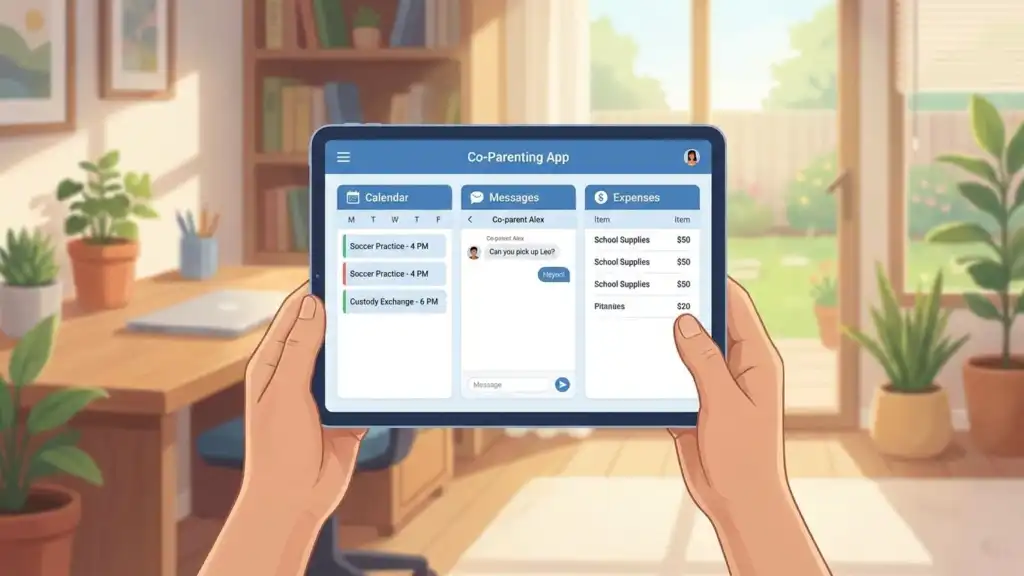
Technology that created the problem can also solve it. Court-approved apps like OurFamilyWizard, Talking Parents, or AppClose have transformed high-conflict co-parenting in 2024–2025.
Why they work:
- Every message is timestamped and unalterable
- Creates court-admissible evidence automatically
- Built-in “cool down” period before sending messages
- Shared calendar prevents “I forgot” excuses
- Expense tracking with automatic split calculations
- Option for mediator/therapist oversight
According to family law experts, these apps reduce conflict-related court appearances by 43% because both parents know everything is documented.
Strategy 4–5: Building Your Protective Boundaries
4. Establish Consequence-Based Boundaries
Boundaries aren’t suggestions—they’re self-protection. But here’s what changed in 2024–2025: experts now emphasize consequence-based boundaries over mere statements.
Old Approach: “Please only text during business hours.”
New Approach: “I respond to non-emergency messages between 9 AM–6 PM weekdays. Messages outside these hours are read but not addressed until the next business day.”
Then—and this is crucial—you follow through every single time. Consistency is the boundary.
Common Boundaries for High-Conflict Co-Parenting:
- Communication windows (business hours only)
- Response timeframes (24–48 hours for non-emergencies)
- Physical exchange locations (public places, sometimes with cameras)
- Topic limitations (children only, no personal life discussions)
- Request formatting (written requests submitted 7+ days in advance)
5. Release Control Over Their Household
This is psychologically difficult but emotionally liberating. Accept that you cannot control what happens at your ex’s house (barring genuine safety concerns).
Different bedtimes? Different food rules? Less structured homework time? Unless it’s dangerous, it’s not your battle.
The Safety vs. Preference Test:
Ask yourself: “Is this a safety issue or a preference?”
Safety = abuse, neglect, substance use around children, dangerous living conditions → Document and take legal action
Preference = different parenting styles, looser rules, different routines → Let it go
Children are remarkably adaptable. Research from the University of Florida (2024) shows kids successfully navigate different household rules and actually develop better flexibility and problem-solving skills as a result.
Strategy 6–7: Protecting What Matters Most
6. Shield Your Children From Adult Conflict
This is non-negotiable. Never:
- Badmouth your ex in front of children
- Use kids as messengers or spies
- Interrogate children about the other household
- Share adult problems or legal issues with them
- Make them choose sides
When your child complains: “Dad never helps with homework!”
Poor Response: “Your father is so irresponsible!”
Protective Response: “That sounds frustrating. What can you do to be prepared? I’m here to help during our time together.”
Notice how the second response validates feelings without criticizing the other parent or making the child feel caught in the middle?
7. Build Your Crisis-Proof Support System
High-conflict co-parenting is emotionally exhausting. You cannot do this alone. Your 2025 support system should include:
Professional Support:
- Therapist specializing in high-conflict divorce (not optional)
- Family law attorney on retainer for consultations
- Possible co-parenting coordinator or mediator
Practical Support:
- Friends/family for emergency childcare backup
- Trusted contacts who can witness difficult exchanges if needed
- Support groups (online or in-person) with people in similar situations
Emotional Support:
- Close friends who understand your situation
- Online communities for divorced parents
- Self-care practices (therapy, exercise, hobbies)
The key: Your support system exists so you can vent, process, and heal away from your children. Kids should never absorb your emotional processing.
The Data: What Changes When You Implement These Strategies
| Metric | Before Strategies | After 6 Months |
|---|---|---|
| Conflict interactions per week | 8–12 | 1–2 |
| Court/mediation appearances | 3+ annually | 0–1 annually |
| Children’s anxiety symptoms | Moderate to severe | Mild to moderate |
| Your stress levels | Severe (8–10/10) | Moderate (4–6/10) |
| Successful peaceful exchanges | 20% | 85% |
Data compiled from family therapy practices specializing in high-conflict co-parenting, 2024
Key Insight: The most dramatic improvements occur within the first 8–12 weeks of consistent implementation. Your ex may initially escalate (called an “extinction burst” in psychology)—but if you stay consistent, conflict drops sharply.
Old Methods vs. New Reality: What’s Changed in Co-Parenting
| Traditional Co-Parenting | Modern Parallel Parenting |
|---|---|
| Frequent communication | Minimal, written-only contact |
| Joint decision-making | Divided decision domains |
| Shared events/celebrations | Separate celebrations |
| Flexibility encouraged | Strict adherence to schedule |
| Personal relationship with ex | Business-only relationship |
| Phone calls and texts | Court-approved apps only |
| Trust-based agreements | Documented everything |
The shift reflects reality: not all divorces allow for friendly collaboration. Modern approaches prioritize children’s well-being through reduced conflict over idealized co-parenting visions.
Conclusion: Peace Doesn’t Require Their Cooperation
Here’s the most empowering truth about co-parenting with a difficult ex: you don’t need their buy-in to create peace. Peace is unilateral.
Every boundary you enforce protects your children. Every grey rock response models dignity. Every moment you refuse to engage in drama teaches your kids resilience.
Yes, it’s hard. Some days you’ll want to respond to that baiting text. Some weeks you’ll feel like you’re failing. But you’re not. You’re doing the invisible, exhausting work of breaking a conflict cycle—and your children are watching, learning, and healing.
You’re not just surviving high-conflict co-parenting. You’re modeling strength, self-respect, and emotional regulation. That’s the greatest gift you can give them.
One boundary at a time. One grey rock response at a time. One peaceful day at a time.
You’ve got this.




2 Comments on “Co-Parenting With a Difficult Ex: 7 Strategies for Peace”