

Why does divorce hurt so much for men, even when the marriage was clearly failing? Because, in many cases, divorce doesn’t just end a relationship it collapses an entire identity system at once: partner, provider, father, home-base, future plan.
And yet, while friends might say “you’ll bounce back,” the body often disagrees. Instead, the chest tightens, sleep breaks, appetite swings, and the mind loops on memories like a stuck song because, neurologically, the loss can register as a threat, not a choice.

Why This Topic Matters Now (and why does divorce hurt so much)
Divorce is not “rare,” and that’s exactly why this conversation matters in 2024–2025. For example, U.S. data shows divorce remains widespread: the CDC reports 672,502 divorces and a 2.4 per 1,000 population divorce rate (provisional 2023, reporting states). Meanwhile, refined measures using the American Community Survey estimate 986,810 women divorced in 2024, with a refined divorce rate of 14.2 divorces per 1,000 married women.
However, the bigger shift is what divorce collides with right now: a social-connection crisis. In fact, the U.S. Surgeon General’s advisory links loneliness and social isolation to serious health risks, including higher risks of heart disease and stroke, and increased risk of premature death. Therefore, when divorce shrinks a man’s daily emotional support, the impact can be amplified by an already-fraying social fabric.

Myths, Mistakes & Misunderstandings
Divorce pain often lasts longer when men try to “logic” their way out of biology. So, clearing up the myths becomes a real recovery tool.
Common myths (skimmable)
- Myth: “If he didn’t cry, he didn’t care.” However, many men show grief through irritability, numbness, overwork, or risk-taking.
- Myth: “Dating quickly fixes it.” Instead, rebound intensity can temporarily mute loss while keeping the nervous system on alert.
- Myth: “Real men handle it alone.” In fact, isolation is one of the strongest accelerants of post-divorce decline.
- Myth: “The pain is just emotional.” Meanwhile, research shows divorce is linked to measurable health risks, including higher mortality risk—especially for men.
- Myth: “Time heals automatically.” Therefore, without new routines, support, and meaning, time can simply repeat the same wound.
Myth vs Truth Table
Actionable Tips & Practical Strategies
Pain becomes dangerous when it stays private. So, the goal is not “toughness,” but regulated rebuilding emotionally, socially, and physically.
1) Treat it like a nervous-system injury, not a mood
First, stabilize sleep, food, and movement. Because stress biology thrives on chaos, basic structure reduces the “threat” signal.
Mini case example: A 41-year-old newly divorced father starts waking at 3 a.m. nightly. Instead of searching for closure texts, he sets a rule: phone charges outside the bedroom, and he walks 15 minutes after dinner. Consequently, the rumination window shrinks, and sleep slowly returns.
2) Build a “two-layer support system” (not one person)
Next, split support into:
- Layer A (emotional): 1–2 trusted humans (friend, sibling, men’s group)
- Layer B (professional): therapist/coach, or structured support
Moreover, men are often less likely to access psychological therapies than women, which can delay relief and skills-building. Therefore, choosing support early is a strength move, not a weakness move.
3) Reduce “contact whiplash”
If co-parenting requires contact, keep it structured. For example, use written, logistical messages and avoid late-night emotional conversations. As a result, the brain gets fewer “reopen the bond” cues, which can otherwise keep stress high.
4) Rebuild fatherhood identity on purpose (if kids are involved)
After divorce, fathers can face a painful loss of daily role. Meanwhile, research on divorced fathers shows that reduced contact with children is strongly tied to lower well-being, and some divorced fathers report no contact at all. Therefore, creating predictable rituals (two weekly calls, one shared hobby, one consistent pickup routine) protects both bonding and mental stability.
Additionally, a practical framework helps see the co-parenting after divorce guide for routines that reduce conflict.
5) Replace “Why me?” with “What now?” using a micro-plan
Finally, use a 14-day micro-plan:
- Day 1–3: stabilize sleep + meals
- Day 4–7: contact one friend daily (short counts)
- Day 8–10: start one fitness habit
- Day 11–14: schedule one professional support session
Ultimately, momentum beats motivation, especially when the brain is depleted.

Data, Quick Definitions & Trend Insights
Divorce pain can feel “mysterious,” but the mechanisms are increasingly clear. For example, social rejection activates brain regions linked to distress and pain processing; an fMRI study found the anterior cingulate cortex (ACC) more active during social exclusion, and that activation tracked self-reported distress. So, when a marriage bond breaks, the brain may interpret it as danger, not just disappointment.
Next, stress doesn’t stay in the mind. In fact, partnership breakups and long periods living alone have been linked with higher inflammatory markers in men, including increases in CRP and IL-6 among men with multiple breakups. Consequently, emotional pain can translate into physical wear-and-tear over time.
To make the risk pattern concrete, the latest global evidence is striking. Moreover, a 2025 systematic review and meta-analysis found separated/divorced men had higher odds of suicidal ideation, attempts, and death by suicide compared to married men. Therefore, post-divorce suffering is not “dramatic” it can be statistically dangerous.
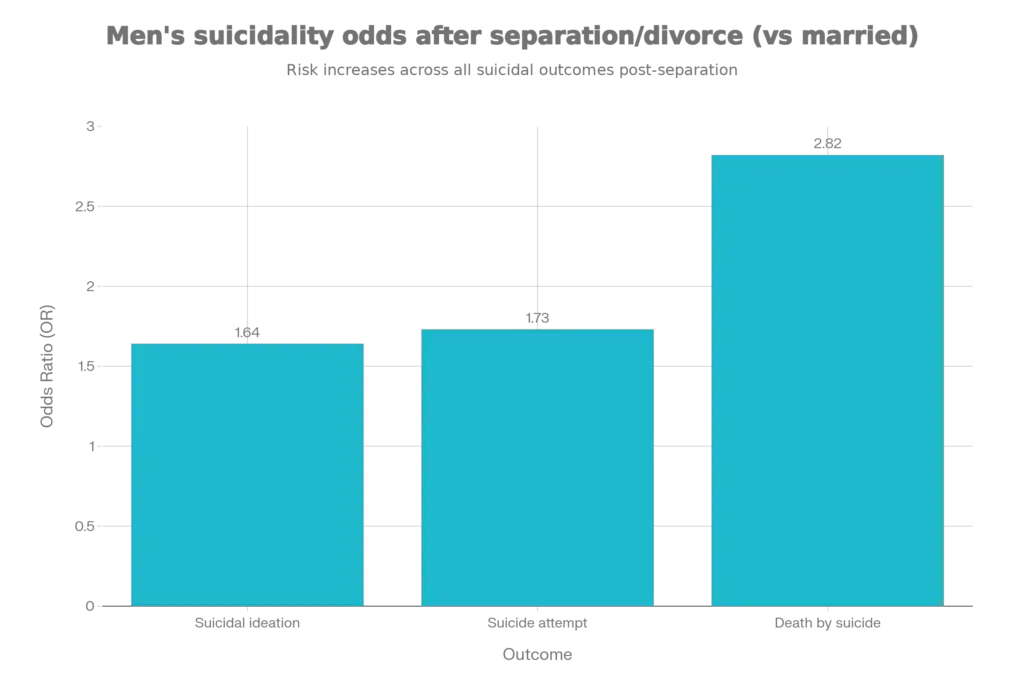
Odds ratios (OR) for men after separation/divorce versus married men across three outcomes
The official definition helps here, because divorce often triggers grief that looks like anger, bargaining, numbness, and finally acceptance.
The Surgeon General’s research explains how weak social connection raises risks for heart disease and stroke, and it also increases premature-death risk.
Comparison Breakdown
Men often heal faster when they shift from “endurance” to “repair.” So, here is a clear breakdown that makes the pivot practical.
Traditional vs Modern Recovery Approach (Table)
| Traditional (“Just push through”) | Modern (“Process and rebuild”) |
|---|---|
| However, avoids emotions until they explode later | Instead, names emotions early to reduce their intensity |
| Meanwhile, uses work, alcohol, or distractions as coping | Additionally, uses structure, exercise, and support as regulation |
| Similarly, seeks quick validation via rebound dating | Alternatively, rebuilds identity first, then dates from stability |
| Consequently, co-parenting becomes reactive and conflict-prone | Therefore, co-parenting becomes scripted, calm, and child-centered |
| Ultimately, loneliness deepens because “no one can know” | In the end, connection grows because support is treated as essential |
Conclusion (Emotional + Motivational)
Divorce hurts deeply for many men because, psychologically and biologically, it can function like a sudden “bond injury”and the body responds with threat, stress, and craving for repair. However, the pain is not proof of weakness; it is evidence that attachment, meaning, and identity mattered.
Therefore, the path forward is not to erase the past overnight, but to build a new life system that can hold the loss without collapsing. Ultimately, when routines stabilize, support increases, and fatherhood (or purpose) becomes intentional again, the nervous system learns safety—and the future becomes real.